



🎧📖▶️ Listen to the audio above, read it as an essay below, or click here (or scroll down) to jump straight to the YouTube video.
Good news, my friends, I’ve finally finished the first draft of my new spec feature script and, to make things even sweeter, my producers have sent to script on the second draft of the TV pilot I was commissioned to write.
Today, I want to talk a bit about process when it comes to second drafts like these (as well as a few other things you might find interesting such Obsession and Backrooms). Every writer approaches rewrites differently, but I think it’s incredibly important to hear from as many different perspectives as possible and experiment with them in your own process.
So, let’s dive in another edition of The Brew together – a corner of this newsletter/podcast where I share what I’m struggling with and sometimes even getting right as an artist in the 21st century.
I’m about to spend two weeks on a semi-break, not because I’m celebrating these screenwriting accomplishments, but because my American brother- and sister-in-law and my niece and nephew will be coming to stay with us here in Australia.
Family is the number one reason for this break, obviously. Mental health, too. I work too much, so I do have to stay vigilant about slipping into self-defeating work habits. But the not-so-secret reason is I need perspective on my two writing projects before I dive into their second drafts.
So, how do I achieve that perspective?
Let’s start with the spec feature. I’ve spent some three months working on this thing. That’s a bit longer than I normally would like to devote to something like this, but there was that pilot to work on, some fiction pages I had to rewrite, and, oh yeah, this newsletter and podcast to maintain. Don’t forget my family.
From experience, that amount of time spent on a single draft has some advantages – but also some disadvantages I really hate. The advantage is I get to rewrite as I go – a lot. Write a scene, rework it, write some more, go back and rewrite something based on new discoveries about the story and characters. That’s great. That’s fun.
The disadvantage is you can get lost in the story. You spend so much time trying to make everything work, you fail to just push through and get to a point where trusted friends can tell you where the big problems are.
You start second-guessing, I mean.
You start “fixing” things with a kind of fanatical energy, getting lost in the weeds so to say.
And when this happens – at least from my experience – your anxiety, your insecurity about your work starts to skyrocket.
Luckily, I think I wrapped the draft right before that became an issue. I’ve been doing this long enough to know what was happening – I could feel it. So, even though there were two scenes I’m not confident remotely work, I said, “Enough – good enough, at least – let’s get some perspective.”
Which brings me to this two-week mini-break of sorts and what I’m going to use it for to set me up for a killer second draft – I hope.
First, my wife Lindsay Devlin – who is a produced screenwriter herself, not to mention an ex-development executive – will read it for the first time. She’s read bits and pieces already, but this will be her first chance to read it as a whole, start to finish, including the ending that I’ve kept hidden from her. Lindsay is brilliant at story, especially identifying emotional holes in the narrative. In my case, also identifying places where my sensibilities have veered away from the more commercial.
You might recall from previous editions of The Brew, this is a commercial action-adventure script, the kind I broke into the business writing.

I think I’ve taken my craft to another level, based on 10 years of writing more arthouse fair, UK pilots, and literary fiction – but we’ll see. I’ll let Lindsay tell me that, including those places where I’ve discussed with you I’m worried I’ll get in my way about, because I have a very specific mandate here: character-driven fun, hide the medicine in the sugar cake, and make people cry happy tears.
After Lindsay, my first line of defense, gives me notes, I’ll quickly address her major issues and polish up the rest. I won’t necessarily address every note she has yet, though. The key with this read is making sure it’s ready to share with people who know nothing about it.
At this point, I’ll send it off to a very small group of trusted readers – probably three or so.
What I want out of these reads is very basic. “Tell me how it makes you feel. Tell me what doesn’t make sense. Tell me where you think I failed to achieve my goals.”
I think it’s important to remember this process is painful and you cannot rush it if you want to do good work. Striving to achieve a perfect draft in isolation usually just slows you down and sooner or later becomes a way to hide from facing the results of your labor.
I like to speed things up. Get in there and get some brutal responses that help me quickly identify all the ways I failed. Perspective, like I said.
The feedback from this first group of readers accomplishes that – along with me stepping away from the project for a couple of weeks. By the time my in-laws leave, I should have a clear sense of what’s working, what isn’t, and what I have to do to accomplish my goals with the script’s second draft.
And before you think that draft is the finish line, it’s not. That 2nd draft will go back to my wife, then another four or five readers.
This new group of readers will be curated from a variety of backgrounds that hopefully don’t resemble mine. At least a couple more women, to stress-test my work from the feminine POV. At least one of this group of readers has to be from outside the US, but preferably half of them. And at least one of them has to be a person of color to further stress-test my work from outside my lived experience.
If I’m lucky, most will primarily create in genres and corners of cinema different than my script’s, too. I’m much more interested in a rom-com writer or horror director or animated film writer’s take on my work than someone who lives and breathes the same air every day. An example is when I had my friend Meg LeFauve, writer of both Inside Out films, read my post-apocalyptic mostly silent horror script. Her notes were amazingly helpful.
Is my process different with a TV pilot commission like the one I was just sent to 2nd draft on? Yes, yes it is.
But that’s primarily because a project like this one already comes with a built-in team of consultants. Every time I have a story question, I have five different people I can run it by. If I want to discuss a scene, I can get two or three of them on the phone to break it down.
In the case of my first draft, we got on Zoom and carefully dissected everything they had questions about to find the best way to push the script forward.
All that said, my first line of defense remains my wife Lindsay – who reads my draft of everything before it’s shared with another human being, even my employers.
Later, if I find myself struggling to get on the same page as those employers, typically my producers, I will turn to friends to read my work and tell me what I’m missing – if anything. Though to be honest, that rarely produces story help. My friends are all pros and every time I’ve tried this, they tell me I’m in the right. Writers know what writers do and what makes a story work.
What pros do know is how to help you navigate the politics of these creative roadblocks based on their own experiences. My dear friend Harley Peyton – brilliant writer, wrote/co-wrote some half of the original “Twin Peaks” series – is especially good at telling me what to say to get producers off my back. He’s been doing that for me since “Dracula”, which he was a co-EP on.
I hope any of this is helpful for you as you prepare to dive into the second draft of your own script. I don’t know what’s going to come next for mine, but, god, I know I haven’t had this much fun writing a feature in a very, very, very long time. If you feel like it, jump into the comments and tell me about your strategies for finding perspective on and tackling your second drafts.
In other news, I finally got to see both Obsession and Backrooms and, holy shit, guys, they are brilliant. If you haven’t checked them out, do so immediately. They’re exactly the kind of films you need to see in a cinema, too, surrounded by people – and if your cinema is anything like mine, you will be.


I haven’t seen audiences show up in such numbers for films in a long time, including the biggest blockbusters. For example, I saw Obsession the same week The Mandalorian and Grogu was released. There were two people there to see Mandalorian and Grogu – my son and me. But there were seventeen people there to see Obsession…in a regional Australian town.

I’d rather not get into what either is about – that’s easy enough for you to find out yourself anyway – but what I think is especially exciting about Obsession is the intense debate it’s provoked. It’s a cinematic Rorschach Test.
I mean, I think it’s very obviously a feminist film – and I know a lot of women who think so, too – but I also know women who think it’s deeply misogynistic. I know Black people who think it’s a privileged white boy stealing ideas from a Black filmmaker and making a lot of money doing it. I know filmmakers who have called it a perfect film and others who groaned they never recovered from how boring the first act was.
That is great art, as far as I’m concerned. You want to argue about it with your friends. For me, the discourse is exciting and part of the fun – and it’s really hard to have great discourse come out of the latest IP-driven film Hollywood’s major studios told you is all you deserve.
Beyond the new films I’ve checked out, I also got to take my eldest son, who is 11, to see my favorite film of all time on the big screen – Lawrence of Arabia.
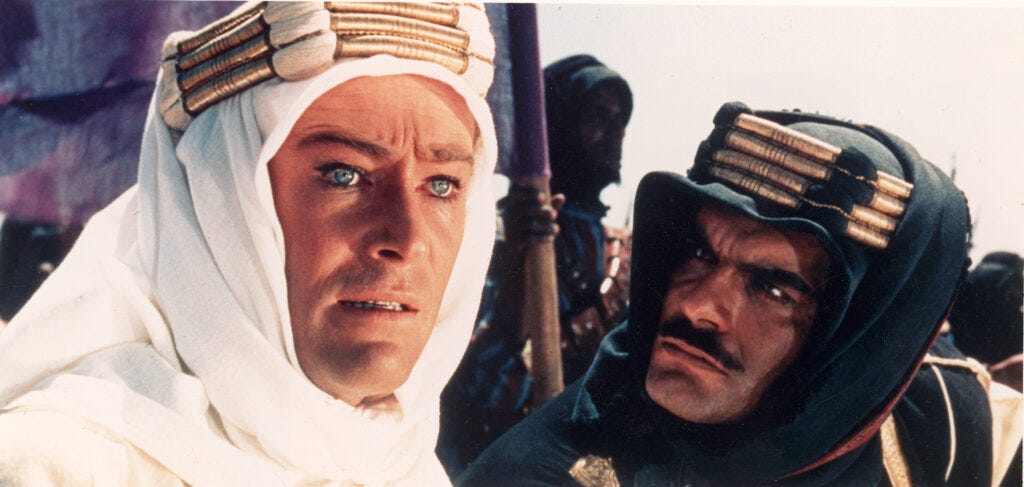
I had people coming up to me at the intermission saying how amazing it was that he could sit for so long at a film and how cultured he was compared to them at 11 and, you know, similar. I don’t know how much he truly enjoyed the film, though he does insist he loved it. I don’t know if he’s especially cultured either, though I do think he’s incredibly adept at interrogating stories for someone so young – probably the result of having storytellers for parents. But I do know that he pushed up the arm rest between us, cuddled up to me, and we watched most of its four-hour run time with our arms around each other.
I’ve loved sharing things like Star Wars and Raiders of the Lost Ark and Lord of the Rings with him, but I don’t know if any of those experiences come close to how much fun I had seeing Lawrence of Arabia this way with him.
A core memory, as my friend Meg would say.
I’ll leave you today with an artist’s quote, which I like to share wat the end of every edition of The Brew. This one comes from Jodi Picoult, author of some 40 novels including My Sister’s Keeper. She said:
“You can always edit a bad page. You can’t edit a blank page”
This is important to remember as you write. Preparation is great, but at some point, if you’re too afraid to start – and finish – you’re not going to get to the point where you discover how much work you still have to do.
God, I love rewriting. Really. If you’re not enjoying it yourself, then I’d argue you’re doing it wrong.
If this podcast episode adds anything to your life but you’re not up for a paid subscription, you can still support my work here by buying me a “coffee”. It’s hugely appreciated - and you might even get a shoutout in the Notes!
OTHER EPISODES/ARTICLES LIKE THIS ONE YOU MIGHT ENJOY
How to Stop Worrying and Love the Rewrite - Part 1

There’s a saying that most storytellers will hear throughout their lives: writing is rewriting. I’ve never been able to source this quote conclusively — Ernest Hemingway often gets the credit — but I suspect it’s a sentiment that’s been around since at least the time of Aeschylus. That’s because it’s true.
☕ The Brew | How I Picked My Next Spec Screenplay

🎧 LISTEN to this 5AM StoryTalk episode as audio here at Substack.
Why Writers Want to Murder You When You Give Them Notes

🎧 LISTEN to this 5AM StoryTalk episode as audio here at Substack.


