


Not so long ago, I had lunch with a screenwriter. As screenwriters do when they get together, we talked about what we were working on. She had a new spec she’d just nailed, and I asked her to tell me about it. As she did, though, I predicted how the entire story would unfold based on the initial concept. When she began to pitch some of the major beats out, my suspicions were so confirmed that I interrupted and told her what was going to happen next. It was rude and I didn’t mean to, but it happened and I feel bad about it. That said, I wasn’t wrong.
That’s because the spec had been written – and explained – using an incredibly formulaic approach to screenwriting that evolved, I’d argue, from a lot of exciting, interesting, and very successful commercial films of the 80s and 90s. By 2005, the year I arrived in Hollywood, all these original stories – many that broke rule after rule – culminated in a screenwriting guide called Save the Cat: The Last Book on Screenwriting You’ll Ever Need.
Well, I’m here to tell you it’s not and, if anything, you shouldn’t think of it as much more than one approach – one of many you should learn and consider, before you throw it out and start doing your own thing.
As Picasso said, “Learn the rules like a pro, so you can break them like an artist.”
If you don’t, you end up pitching me a spec script you just wrote based on an outline I could’ve guessed from the concept alone.
Am I especially gifted when it comes to Hollywood structure? I wouldn’t say gifted, but I would dare to say I know it like a pro at this point.
A good friend, a producer, once said to me, “I told the studio, listen, Cole knows structure better than any other screenwriter I know. Let him nail the first draft, then we’ll hire someone to tackle the character work.”
A. I think he thought this was a compliment. It – It was not.
B. I’ve often cited this exchange as a reason I was so happy to leave Hollywood for the U.K., because my British agents and every British producer I met thought I was a character writer instead – but that’s a story for some other time.
What I’m trying to say is: I have studied American screenplay structure in all its variations inside and out through analyzing films themselves, which I think is a much better way to do it than memorizing a screenwriting guide’s beat sheet. I’m referring again to Save the Cat here, which has a beat sheet that’s become so common, so ubiquitous that even Final Draft helps you use it.
Because of its role in brainwashing emerging screenwriters and young development execs, I can now, all too often, predict what’s coming next in a film. This is a big reason why 4/5ths of the films I watch every month were produced before Save the Cat became the default setting for Hollywood storytelling and, by way of its influence on the world, sometimes the films produced elsewhere.
See, I want to be surprised. But if you follow Save the Cat’s beat sheet, I – and audiences – generally won’t be.
Oh, they might not register it – the audience I mean – but there is a familiarity to narratives now that leaves viewers incredibly passive. They’re all too often not required to participate because the story’s emotional and plot beats are on a kind of cruise control until the credits start to roll.
Sit back, let it happen to you, go home.
Hey, I don’t know, crazy idea…but maybe that’s one of the reasons why the theatrical experience has struggled in the past decade?
When every franchise movie hits all the same beats, you get bored. You find something else to do. Because we crave surprise when we go to the movies.
Now, here’s the thing for screenwriters, aspiring and emerging and, all too often, established: pulling this off is a catch-22.
Today, the vast majority of development execs, studio execs, and so on have been trained on Save the Cat and the majority of their careers have been built on understanding Save the Cat’s beat sheet as the exemplar of what a great film is. I’ve had a producer – quite literally – pull a copy of Save the Cat out to tell me why I was doing something wrong.
Consequently, such readers’ intellectual metric of what makes a great film is Save the Cat, which was written by the late screenwriter Blake Snyder.
But the Catch-22 I mentioned?
That’s what their emotional metric is, which is the desire – nom the need – to be surprised.
Like moviegoing audiences, they need something new and surprising to happen to them while reading your script, or else it won’t really register with them.
This is one of the reasons why spec scripts by new (or rather, emerging) screenwriters make so many appearances on the Black List, I think. They’re screenwriters doing something different, something fresh, and it surprised people enough to hire them to write something by the book – and when I say by the book, of course I mean according to Save the Cat.
I wish I could tell you how to navigate this Catch-22 after you break into the business and everyone expects you to fall into line and write with Blake Snyder’s voice in your ear. The best chance of doing that, I’d say, is getting lucky enough to pair with a filmmaker or two who manage to encourage and protect your voice. Not easy to do.
But upfront? That’s a different story because you’re trying to get people’s attention. How do you surprise them when they’re convinced the only way a script is good is if the protagonist saves a metaphorical cat somewhere early in the first act? Or, frankly, any of the other rules laid out in Save the Cat?
Which brings us at last to the point of this episode of 5AM StoryTalk:
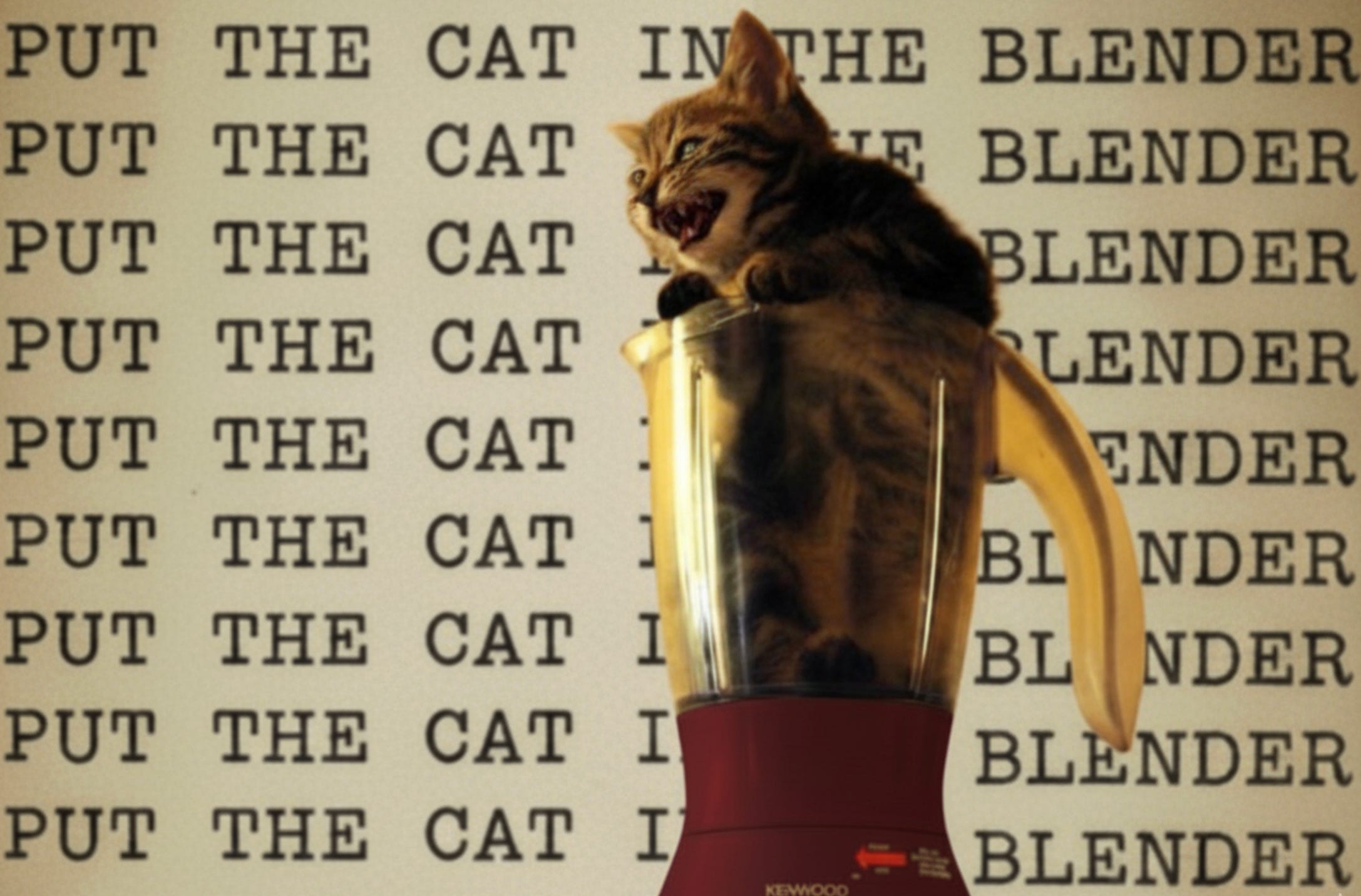
You put the cat in the blender instead.
Let me explain what that means so PETA doesn’t come after me.
In the distant time when I still lived in L.A., someone in my life transitioned from producer to screenwriter. They wrote a psychological horror spec I loved, but I was bumping on a scene that felt…safe to me.
It got the job done, yeah, but I saw an opportunity to surprise the reader. I argued they needed to do something so audacious on the page that it made the reader gasp – like, “Holy shit, I’ve never seen that before!” But most importantly, so audacious it sent the reader running to their boss to tell them, “You’ve got to read this script!”
In the aforementioned script as is, the protagonist goes into a kind of hallucinatory state and wakes up to discover she killed her beloved pet cat with her conductor’s baton. Just sort of stabbed it over and over, some blood splatter, you get it.
My suggestion:
This protagonist had to wake, go into the kitchen, and find blood all over the cupboards, the floor, the counter, the walls, everywhere.
What the fuck, right?
Picture the end of Fargo, but inside an apartment’s galley kitchen.
And there, in a blender, is what remains of her cat with the conductor’s baton sticking out of it since she used the baton to keep jamming – stabbing – the cat into the blender as was, uh, blended up.
Like I said: put the cat in the blender.
On one hand, this struck me as such a perfect rebuke of the absurdity I saw in using Save the Cat – especially that save the cat term – when writing your own screenplays.
On the other, it suggested a scene that could be immediately iconic, the kind of scene people would talk about coming out of the theater, the kind an exec might run into their boss’s office to shout, “You’ve got to read this script!” about.
In the years since I offered this advice, “put the cat in the blender” has become, for me, synonymous with subverting Save the Cat. When I give notes on a script, I’ll often bring up this theory when discussing the first act. How do we blow up expectations of what to expect from the script? How do we take the predictable, that paint-by-numbers beat sheet stuff, and turn it on its head?
In as many scenes as possible, too. Not twists. Twists are just cool plot devices.
But something that defies the expectations created by a 20-year-old screenwriting guide that always, in my opinion at least, always seemed to miss the point about what made great movies work – which is a kind of handmade quality, as much singular life experience as creative spontaneity and inspiration.
What I mean by that is, a sense that an author is present in the story, that decisions were made that were more “what if” or “and then” – both great ways to move from one scene into the next – rather than “what does Blake Snyder’s beat sheet say we need to do next?”
One involves qualities I would describe as artistic, original, authentic to the storyteller themselves.
The other sounds a lot like asking ChatGPT to write your first draft…which might be why so many people now think they can write something as good as a Hollywood film using generative AI.
Which might also be why so many people also can’t be bothered to spend a small fortune to go to movie theaters to see Hollywood films they’ve consciously or unconsciously come to find safe, uninspired, and even creatively inert.
I want to provide a recent example of a film that I would describe as the exact opposite of everything I just said about Hollywood films - but I warn you now, it involves a spoiler about the midpoint of Sinners from writer-director Ryan Coogler.
Which is another way of saying, if you’re not okay having it spoiled for you, walk away now…
Still here?
So, at the start of Sinners, a narrator tells us:
There are legends of people born with the gift of making music so true, it can pierce the veil between life and death, conjuring spirits from the past and the future.
This gift can bring healing to their communities, but it also attracts evil.
Great set-up and, according to Save the Cat, the veil-piercing musical event should happen at the first act turn to set the film’s real action in motion.
Instead, Coogler gives it to us as a midpoint plot reversal – turning the whole film on its head.
That itself is unconventional – sort of the equivalent of putting a tiny little kitten in a blender.
But he shoves a cat in there, too, when our blues musician protagonist starts to play a song so true that past and future begin to mingle with the present.
What I mean is, Jimmi Hendrix literally shows up.
And tribal musicians from Africa – from before the Great Atlantic Slave trade destroyed millions of lives – begin to dance.
And soul singers, and breakdancers, and rappers, and hip-hop dancers.
The Black American musical story, which is far more of a continuum – predicated on storytelling that is hundreds of years old and ongoing – plays out before our eyes and it is…it is…glorious.
I’ve never seen anything like it.
None of it was necessary for Sinners to make sense, and yet it’s so specific, it’s so singular, that it’s exactly why this midpoint reversal transcends plot and will be talked about for decades to come.
I mean, surprised was the least of what I felt. Which is why today I’m telling you about it, because Sinners – because Ryan Coogler – had to buy blenders in bulk to get rid of all the metaphorical cats he decided to mass-murder with this film.
Sinners is so damn good, so damn original, so damn audacious that it turns people into evangelists on its behalf.
Long story short, screenwriters: put your cats in the blender.
Blend them up.
Splatter everything with all their gross little cat bits.
Because who knows what’ll happen next then?
Which is kind of the point for your characters, your initial readers and, hopefully - eventually - your audience.
If this article added anything to your life but you’re not up for a paid subscription, help me keep the lights on at 5AM StoryTalk by buying me a “coffee”. Thanks!
If you enjoyed this particular article, these other three articles/podcast episodes might also prove of interest to you:
How to Write Better Dialogue (While Becoming a Better Person)

Welcome back to 5AM StoryTalk’s Podcast, my friends. Today I’ll be talking about my game-changing secret about how to write better dialogue in whatever medium you’re creating in. But the episode is about more than that, as you’ll find out — there’s a reason why its title is “How to Write Better Dialogue (While Becoming a Better Person)”, I mean.
How to Survive the Sad, Uncertain Life of an Artist

This week brings you the first minisode of 5AM StoryTalk’s Season 2. I wanted to start the new season with something that’s been on my mind lately – and the minds of many of my friends – which is how we’re expected to survive as artists. Not just in 2025, but going forward, too, as the world’s creative industries become…
The Horror of 'Dracula': The Unbelievable True Story of the 2013 TV Series - Part 1

How could a straight-to-series greenlight go so wrong for the first TV series I ever created?!


